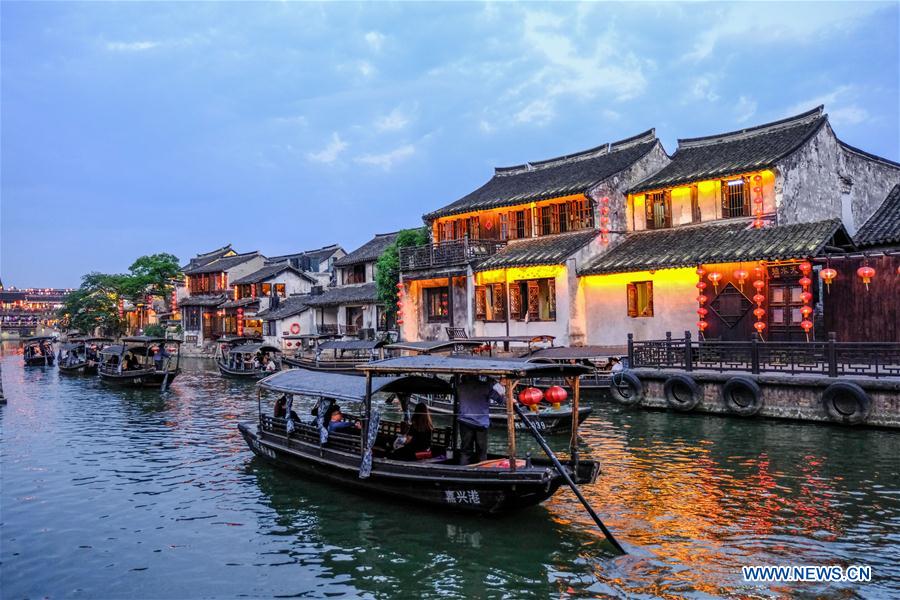
Xitang Ancient Town
Introduction
Xitang Ancient Town, a national 5A scenic spot and one of the six ancient towns south of the Yangtze River, is located in Jiashan county, Jiaxing city, at the junction of the two provinces of Jiangsu and Zhejiang, as well as Shanghai. This charming historic town boasts well-preserved Ming and Qing architecture. It is built along river, and has 27 stone bridges, 122 old lanes and many corridors that constitute the primary characteristic of the ancient town.
History
An ancient town with a long history, rich cultural resources and beautiful natural scenery, it is also the birthplace of ancient Wu and Yue Culture. Xitang once lay on the border between the Wu and Yue Kingdoms. In Tang Dynasty (618-907), a large number of villages had been built in Xitang. Later, in the Southern Song Dynasty (1127-1279), as villages expanded in scale, economic activities in the region grew.
Gradually, Xitang became an important market town, and businesses began to flourish in early Yuan Dynasty (1271-1368). Xitang became the center of handicraft and commercial in southern China from the Ming Dynasty (1368-1644).
Architecture
Compared to the other towns in Southern China, the major difference lies in the 1000 meters long street porches in Xitang. Xitang is famous for its bridges and long porches, which serve as a mirror of ancient Chinese traditional culture. The majority of buildings in Xitang were built during the Ming Dynasty or Qing Dynasty (1644-1911), reflecting the architectural styles popular during those eras. The alleys of varying lengths in the town have been well-preserved for hundreds of years, with their current number at 122.
There are five alleys that are more than 100 meters in length; of these, Shipi alley is the most famous. Shipi alley is located in the west of Zhongfutang, beside the Wang family house. 68 meters long, the maximum width of the alley is 1 meter, and is only 0.8 meter at its narrowest. The pavement is built using166 pieces of 3 cm-thick stone. Since it is almost impossible to make granite slabs so thin, the name of the alley came to be Shipi, which means "quite thin" in Chinese.
Tourism
With the passage of time, the walls have become mottled. When one steps into the quiet, long alley, it feels as though they are walking into a tunnel of history, experiencing the feel of ancient Xitang. Night tours in Xitang are attracting visitors who are able to enjoy the town from the comfort of boats decorated with red lanterns.








